Our second day in Germany started with an early breakfast and a hasty departure from Koblenz at 8 in the morning. We had a 4 1/2 hour bus ride, across Germany, to Nuremberg. We had a full day planned in Nuremberg, so once we had quickly checked into the youth hostel, we set off on a whirlwind tour of three churches; the St. Lorenzkirche, Frauenkirche, and St. Sebalduskirche. But first our walk through town...
 |
| The first view of our object of desire, the Church of Saint Lorenz |
 |
| Statues keep watch from every corner. |
 |
But first a brush with more recent history. The Palace of Justice, built 1909-1916,
Site of the Nuremberg Trials of Nazi war criminals. |
 |
| Art where-ever you look! |
 |
| The Church of St. Lorenz, first built in 1445, was well endowed by the local medieval merchant class. In competition with their neighbors across the river, the church of St. Sebaldus, both became treasure houses for medieval art featuring polychrome statuary, carved stone, and stained glass. |
 |
| Saint Lorenzkirche. |
 |
| Stairway to heaven (or to a pulpit) |
 |
Polychrome carvings were a popular donation and often were given as a memorial to family members,
not as effigies but as family commemorations and focal points in the church. |
 |
| Avenging Angels |
 |
| Pretty Saints |
 |
| Beautiful artwork hangs from every wall. |
 |
| The Annunciation, suspended above the Nave for eternity... |
 |
| Lady Madonna with the Holy Spirit landing on her... |
 |
| The Archangel Gabriel |
 |
| Every surface and corner covered with symbolic carving. |
 |
| Don't forget to look up! The arches still have traces of the colorful painting that decorated the stonework. |
 |
| This giant tabernacle was used to hold the remains of the Eucharist (bread and wine) that were used during the mass. It needed to be protected from ill-use, like sorcery or magic. The stone carver was showing off his skill by by "bending" the stone at the top to curve into the roof, like an over-sized Christmas tree. |
 |
| The detailed carving on the tabernacle. |
 |
| A Jesse Tree depicting the blood-line of Christ |
 |
Take a look at the spires to the far left and right.
This window is located right behind the tabernacle with the bent spire and the glass artist has mimicked this in the stained glass. |
 |
| Saintly portraits hung beneath a stained glass window |
 |
Straßburger Werkstattgemeinschaft...
A window by the stained glass co-operative workshop led
by Peter Hemmel in Strasbourg from 1477-1481 |
 |
| An odd depiction of the Four Evangelists represented by their symbols; John as the Eagle, Luke as the Ox, Mark as the Lion, and Matthew as an Angel. They are odd because they are shown with human bodies rather than their beastly form, which is often depicted with wings. |
 |
| Such a divine spiral staircase, featuring bulls eye glass. |
 |
| Birds of Germany then and now. |
After an all too brief time in the St. Lorenzkirche, we rushed across town to go inside the Frauenkirche or Church of Our Lady, before their afternoon services began. Built for Charles IV, Holy Roman Emperor between 1352 and 1362, The Frauenkirche became the home of the Imperial Regalia in 1423.
 |
| The Church of Our Lady, Nuremberg |
 |
| The foyer ceiling. |
 |
| A painted tympanum inside the foyer. |
 |
| The high altar. |
 |
| Sensing a theme here... |
 |
After our quick tour of the Frauenkirche we headed
across town to our final destination, the church of
St. Sebaldus, catching some more sights in
the heart of Nuremberg along the way.
The Schöner Brunnen Fountain above is on the plaza of the city's market in front of the Frauenkirche. |
 |
| Nuremberg is a feast for the eyes.! |
 |
| The Imperial Eagle stands watch over a doorway. |
As we make our way across town to the Church
of Saint Sebaldus, there is so much to see and
so little time to see it. I'll have to go back!
Balconies like this one are all over the city.
 |
| St. Sebalduskirche. |
 |
I am always amazed at the view straight up.
You can just make out the elaborate paint which once covered the arches. |
 |
| This Saint holds a model of the Church of St. Sebaldus |
 |
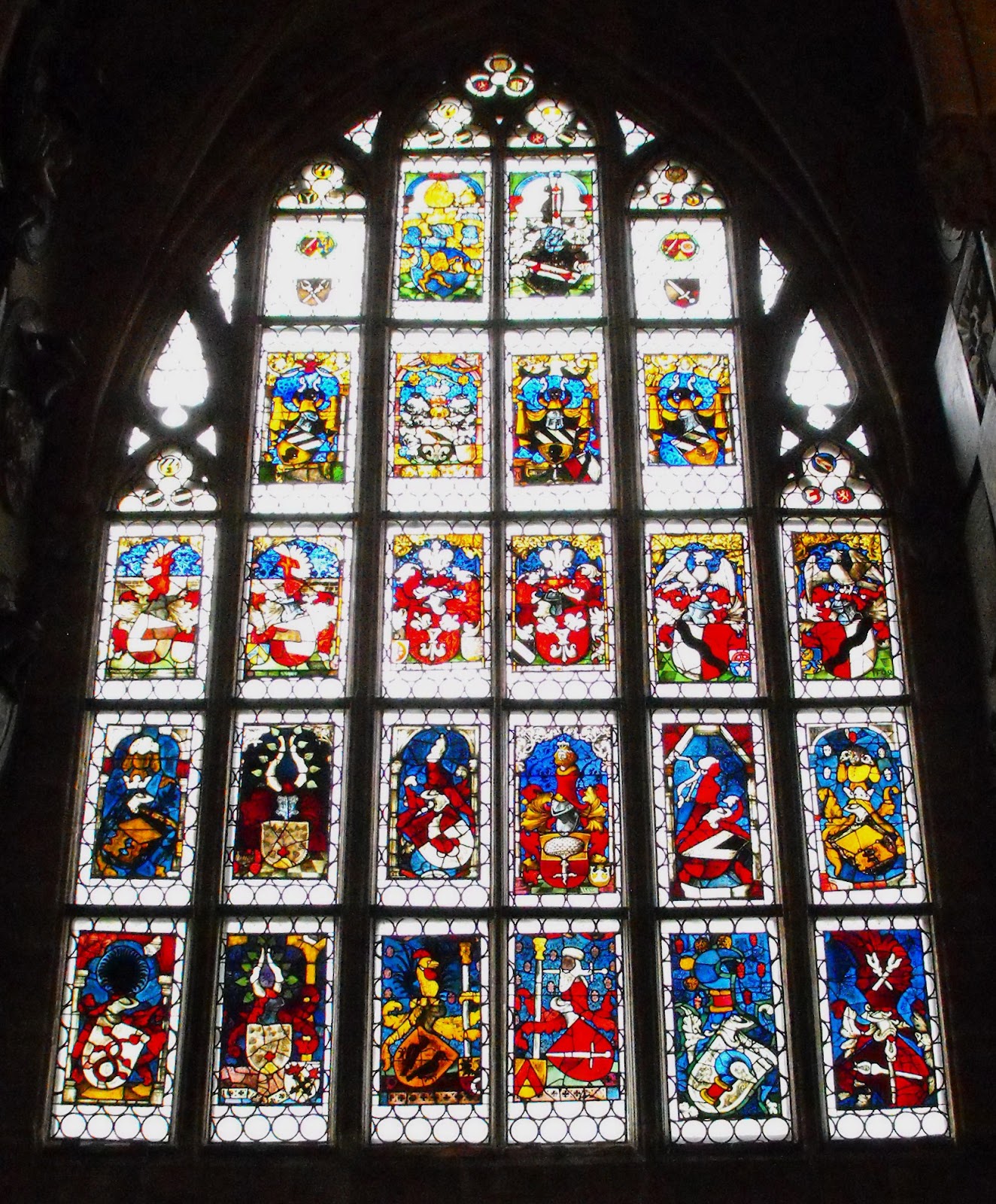
| The Glass here is very different in style partly due to the tall narrow windows. At one point all the windows were cut down and lowered to be shorter than the window introduced in honor of the Holy Roman Emperor. |
 |
This giant bronze reliquary of Saint Sebaldus has one shining face from
centuries of rubbing for blessing/power/ healing. |
 |
Monument of St. Sebaldus in the Sebalduskirche at Nuremberg, the masterpiece of
Peter Vischer the elder and his sons, begun 1508, completed 1519 |
 |
| A late medieval window designed by Albrecht Durer |
 |
| An early medieval window. |
 |
| A pretty painted Saint |
 |
This photo of the Saint Sebaldus Reliquary is for Sofia,
who has a strong disregard for slugs and snails. Can you find the frog and mouse? |
 |
| An up close look at this stained glass panel from the Church of St. Sebaldus reveals the state of medieval glass and gives a good idea of why we need glass conservators. This panel is suffering from paint loss and corrosion. The photo below shows the same panel with reflected light rather than transmitted light, as above. |
 |
| A small side chapel reveals these hidden treasures. |
 |
The vaulting in the side chapel retains its elaborate
paint scheme. |
 |
| Imperial eagles adorn this cabinet. |
 |
Our old friend St. Peter (Patron Saint of York Minster)
bids us Auf Wiedersehen as we leave
the church of Saint Sebaldus. |




.jpg)